
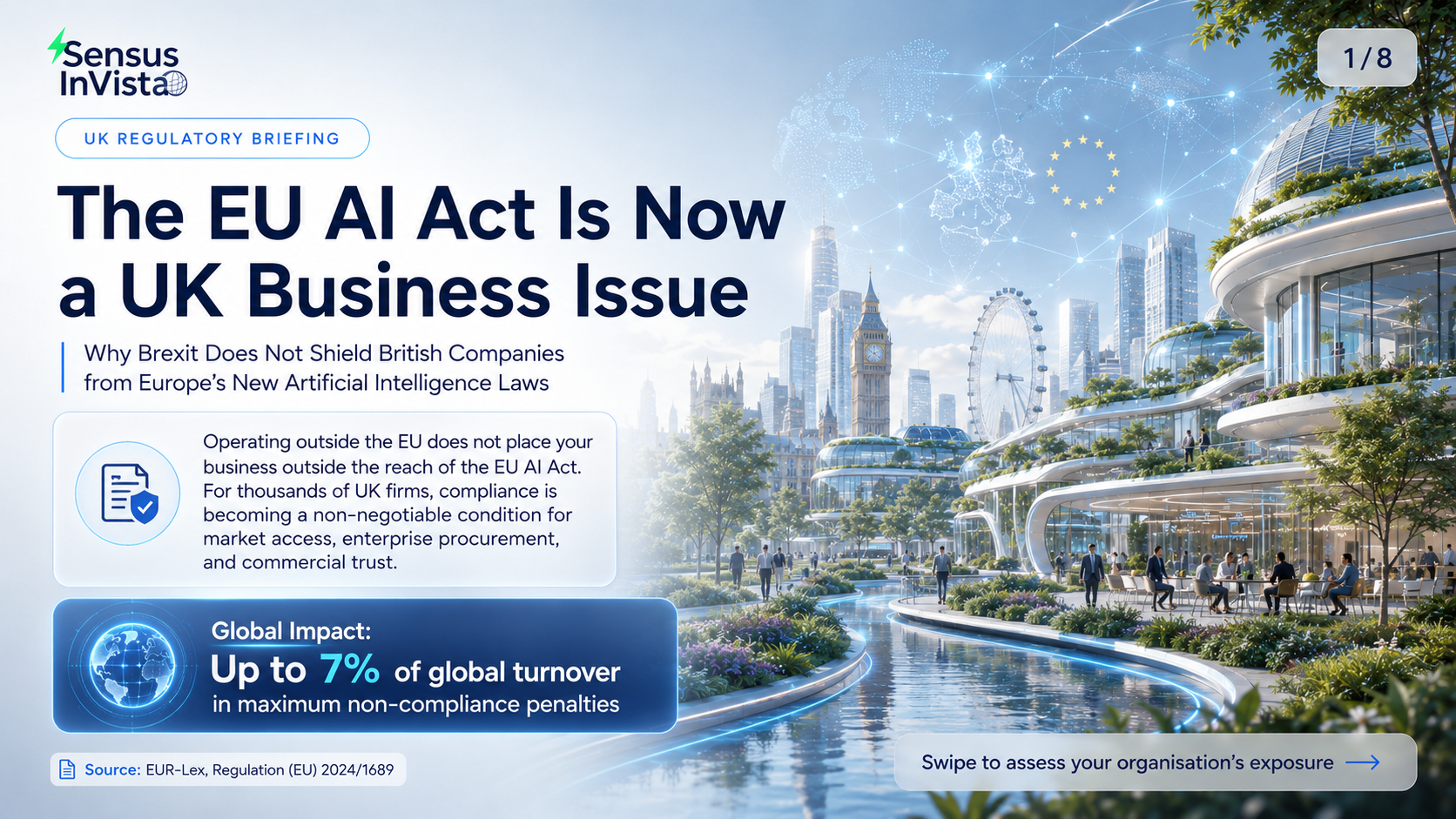
Brexit does not place British companies outside the reach of Europe’s new AI rules. For many UK organisations, the EU AI Act will become a condition of market access, procurement and commercial trust.

The EU AI Act represents a significant change in how artificial intelligence is governed. Rather than regulating AI as a single category of technology, it applies different obligations according to the purpose of a system, the risks it creates and the role an organisation plays in supplying or using it.
For UK businesses, the central question is not simply: “Are we based in the European Union?”
It is: “Does our AI system, service or output enter the European market or affect people within it?”
Under the Act’s territorial provisions, the rules can apply to companies outside the EU when they place an AI system or general-purpose AI model on the EU market, or when the output of an externally operated system is used within the Union. This means a UK software provider, consultancy, online platform or employer may fall within scope without maintaining a large physical presence in Europe. (EUR-Lex)
What the EU AI Act regulates

The Act uses a risk-based structure.
Most everyday applications—such as spam filters, AI-enabled games and basic productivity tools—are considered minimal risk and face few or no additional obligations.
Systems such as chatbots and generative AI tools may be subject to transparency requirements. Users may need to be informed that they are interacting with AI, while certain synthetic text, audio, image and video content must be identifiable or labelled.
High-risk systems face considerably stronger requirements. These include AI used in areas such as:
- Recruitment and worker management
- Education and examination
- Creditworthiness and access to essential services
- Critical infrastructure
- Medical devices and safety-related products
- Biometrics
- Migration and border control
- Law enforcement and justice
Providers of high-risk systems may need risk-management processes, suitable data governance, technical documentation, activity logs, human oversight, accuracy controls, cybersecurity protections and post-market monitoring. (Digital Strategy)
Some uses are prohibited altogether. Existing prohibitions include certain forms of manipulative AI, social scoring, indiscriminate facial-image scraping and emotion recognition in workplaces or educational institutions, subject to limited exceptions. (Consilium)
That last example is particularly relevant to employers. A workplace tool promoted as measuring engagement, honesty, emotional state or cultural fit could create a much more serious compliance issue than an ordinary HR application.
The implementation timetable

The Act entered into force on 1 August 2024, but its obligations have been introduced in stages.
Prohibited AI practices and AI-literacy duties began applying on 2 February 2025. Governance provisions and obligations for providers of general-purpose AI models followed on 2 August 2025. Most of the Act’s remaining provisions apply from 2 August 2026. (Digital Strategy)
Following the EU’s 2026 Digital Omnibus amendments, the main high-risk deadlines have been extended:
- 2 December 2027 for stand-alone high-risk systems, including many systems used in employment, education, essential services and biometrics.
- 2 August 2028 for high-risk AI incorporated into regulated products.
The amendments also provide a transition period until 2 December 2026 for certain providers implementing technical marking requirements for AI-generated content. (Consilium)
These extensions should not be treated as permission to wait. High-risk compliance requires technical evidence, contractual cooperation, testing processes and organisational controls that are difficult to create retrospectively.
Why UK businesses are affected

The most obvious category is a UK company selling an AI product directly into the EU. But exposure is considerably broader.
A British organisation may be affected when it:
- Supplies software to an EU customer
- Operates an online service accessible within the EU
- Provides AI-generated analysis used by an EU office or client
- Employs or assesses workers within an EU member state
- Integrates third-party models into a product sold in Europe
- Distributes or imports an AI-enabled product
- White-labels another company’s AI system
- Makes substantial changes to an existing high-risk system
- Processes European customer or employee information through AI
The organisation’s legal role matters. The Act distinguishes between providers, deployers, importers, distributors, product manufacturers and authorised representatives.
A business that believes it is merely “using” AI could become a provider where it markets the system under its own brand, substantially modifies it or changes its intended purpose so that it becomes high-risk. (EUR-Lex)
This makes AI compliance a supply-chain and contracting issue—not simply a matter for the technical team.
Purchasing AI does not outsource responsibility
Many businesses currently approach AI governance through vendor selection:
“We use a major platform, so the provider will handle compliance.”
That assumption is unsafe.
A model provider may be responsible for the underlying model, while the customer remains responsible for how the resulting system is configured, deployed and used. A recruitment platform, for example, may supply compliant technical documentation, but the employer must still consider human oversight, appropriate use, staff competence and the consequences of acting on the system’s recommendations.
Contracts with AI suppliers should therefore address:
- The organisation’s role under the Act
- Intended and prohibited uses
- Documentation and audit rights
- Training-data and copyright information
- Security responsibilities
- Logging and record retention
- Incident notification
- Model or system updates
- Support for conformity assessments
- Responsibility for substantial modifications
- Termination and data portability
The commercial question is no longer only whether an AI product performs well. It is whether the supplier can provide the evidence needed to use it responsibly.
AI literacy is already a governance requirement

One of the most immediately relevant provisions concerns AI literacy.
Providers and deployers are expected to ensure that staff and others operating AI systems have an appropriate level of knowledge, considering their experience, training and the context in which the system is used. (EUR-Lex)
This does not mean every employee must become an AI engineer.
It does mean that generic awareness training is unlikely to be enough for people making important decisions with AI. A marketing employee using a writing assistant requires different knowledge from a recruiter evaluating automated candidate scores, a developer integrating a foundation model or a manager approving AI-generated financial analysis.
Effective AI literacy should cover:
- What systems the organisation permits
- What data may be entered
- The limits of model outputs
- Hallucination and verification
- Bias and discrimination
- Human accountability
- Confidentiality and intellectual property
- Escalation and incident reporting
Training should be tied to actual roles and systems rather than treated as a one-off compliance presentation.
The relationship with UK law

The UK has not adopted a direct equivalent to the EU AI Act. As of mid-2026, it continues to regulate AI through existing legislation, sector regulators, non-statutory principles and targeted measures rather than one comprehensive cross-sector statute. (House of Lords Library)
However, this does not mean that AI is unregulated in Britain.
Depending on the application, UK organisations may already need to comply with:
- UK GDPR and the Data Protection Act
- Equality and employment law
- Consumer-protection rules
- Financial-services regulation
- Product-safety requirements
- Intellectual-property law
- Confidentiality and contractual duties
- Sector-specific professional standards
The EU AI Act does not replace data-protection law either. Personal data used within AI systems remains subject to applicable GDPR requirements, including lawful processing, transparency, fairness, security and individual rights. (EUR-Lex)
For organisations operating in both markets, the result is a dual compliance environment: a more prescriptive EU regime alongside the UK’s existing, context-led framework.
The financial risk is significant—but it is not the only risk
The maximum penalties under the Act include fines of up to €35 million or 7% of worldwide annual turnover for prohibited practices, and up to €15 million or 3% for a range of other breaches. The Act provides proportionate treatment for SMEs, with the lower applicable maximum used in those cases. (EUR-Lex)
Yet enforcement fines may not be the first commercial consequence.
Businesses could encounter:
- Failed procurement assessments
- Delayed European product launches
- Customer demands for additional warranties
- Loss of access to regulated sectors
- Increased insurance requirements
- Reputational damage
- Contract disputes over compliance responsibility
- Costly redesign of systems that cannot produce adequate evidence
For many UK companies, EU customers will become the practical enforcement layer. Buyers will increasingly ask suppliers to demonstrate classification, testing, documentation and governance before signing a contract.
What businesses should do now
The starting point is an AI inventory.
Businesses need to identify not only centrally purchased tools but also AI embedded in SaaS platforms, recruitment systems, customer-service software, analytics products, creative tools and employee workflows.
Each use should then be assessed against five questions:
- What does the system do, and who may be affected?
- Does any part of its market, operation or output involve the EU?
- Are we acting as provider, deployer, importer, distributor or product manufacturer?
- Which risk category and implementation date apply?
- What evidence would demonstrate responsible operation?
From there, organisations can prioritise higher-impact systems, strengthen supplier contracts, implement role-based training and establish approval processes for new AI tools.
The objective should not be to create a bureaucracy around every chatbot. It should be to apply stronger controls where AI can materially affect people, safety, legal rights or access to opportunity.
Compliance can become a commercial advantage

The EU AI Act will undoubtedly increase the governance burden for some businesses. But it also creates a clearer market for organisations able to demonstrate that their AI systems are controlled, documented and trustworthy.
UK suppliers that build compliance into product design can position themselves as lower-risk partners for European customers. They may also be better prepared for future UK requirements, procurement standards and sector-specific regulation.
The strategic mistake is to treat the Act as a distant European legal issue.
For many British businesses, it is already becoming part of product development, procurement, workforce governance and international growth.
The companies that respond effectively will not be those that produce the longest AI policy.
They will be those that know where AI is being used, understand who is accountable and can prove that their systems operate as intended.
This article provides a general business overview and should not be treated as legal advice.
#ArtificialIntelligence #EUAIAct #AIRegulation #AIGovernance #ResponsibleAI #UKBusiness #Compliance #DigitalStrategy
Additional reading
Based on the themes and references in the supplied article.
- Regulation (EU) 2024/1689 — Artificial Intelligence Act: Official Legal Text
https://eur-lex.europa.eu/eli/reg/2024/1689/oj/eng (Eur-Lex) - EU AI Act: Regulatory Framework and Implementation Timeline
https://digital-strategy.ec.europa.eu/en/policies/regulatory-framework-ai (Digital Strategy) - Navigating the AI Act: European Commission Questions and Answers
https://digital-strategy.ec.europa.eu/en/faqs/navigating-ai-act (Digital Strategy) - Rules for Trustworthy Artificial Intelligence in the EU — EUR-Lex Summary
https://eur-lex.europa.eu/EN/legal-content/summary/rules-for-trustworthy-artificial-intelligence-in-the-eu.html(Eur-Lex) - Artificial Intelligence Act — Council of the European Union Overview
https://www.consilium.europa.eu/en/policies/artificial-intelligence-act/ (Council of the European Union) - Guidelines on Prohibited AI Practices under the AI Act
https://digital-strategy.ec.europa.eu/en/library/commission-publishes-guidelines-prohibited-artificial-intelligence-ai-practices-defined-ai-act (Digital Strategy) - Guidelines on the Definition of an AI System
https://digital-strategy.ec.europa.eu/en/library/commission-publishes-guidelines-ai-system-definition-facilitate-first-ai-acts-rules-application (Digital Strategy) - AI Literacy under the EU AI Act: Questions and Answers
https://digital-strategy.ec.europa.eu/en/faqs/ai-literacy-questions-answers (Digital Strategy) - European Commission Repository of AI Literacy Practices
https://digital-strategy.ec.europa.eu/en/policies/repository-ai-literacy-practices (Digital Strategy) - General-Purpose AI Code of Practice
https://digital-strategy.ec.europa.eu/en/policies/contents-code-gpai (Digital Strategy) - Guidelines for Providers of General-Purpose AI Models
https://digital-strategy.ec.europa.eu/en/policies/guidelines-gpai-providers (Digital Strategy) - General-Purpose AI Models in the AI Act: Questions and Answers
https://digital-strategy.ec.europa.eu/en/faqs/general-purpose-ai-models-ai-act-questions-answers (Digital Strategy) - Code of Practice on Transparency of AI-Generated Content
https://digital-strategy.ec.europa.eu/en/policies/code-practice-ai-generated-content (Digital Strategy) - 2026 Agreement to Simplify and Streamline EU AI Rules
https://www.consilium.europa.eu/en/press/press-releases/2026/05/07/artificial-intelligence-council-and-parliament-agree-to-simplify-and-streamline-rules/ (Council of the European Union) - AI Regulation in the UK — House of Commons Library
https://commonslibrary.parliament.uk/research-briefings/cbp-10003/ (House of Commons Library) - AI Regulation in the UK: The Case for Cross-Sector Legislation — House of Lords Library
https://lordslibrary.parliament.uk/ai-regulation-in-the-uk-debate-on-the-need-for-cross-sector-legislation/ (House of Lords Library) - UK Government: A Pro-Innovation Approach to AI Regulation
https://www.gov.uk/government/publications/ai-regulation-a-pro-innovation-approach/white-paper (GOV.UK) - ICO Guidance on AI and Data Protection
https://ico.org.uk/for-organisations/uk-gdpr-guidance-and-resources/artificial-intelligence/guidance-on-ai-and-data-protection/ (ICO) - ICO AI and Data Protection Risk Toolkit
https://ico.org.uk/for-organisations/uk-gdpr-guidance-and-resources/artificial-intelligence/guidance-on-ai-and-data-protection/ai-and-data-protection-risk-toolkit/ (ICO) - ICO Guidance on Explaining Decisions Made with AI
https://ico.org.uk/for-organisations/uk-gdpr-guidance-and-resources/artificial-intelligence/explaining-decisions-made-with-artificial-intelligence/ (ICO)



Innovation over Expansion: A Case for Alternative Model Availability