
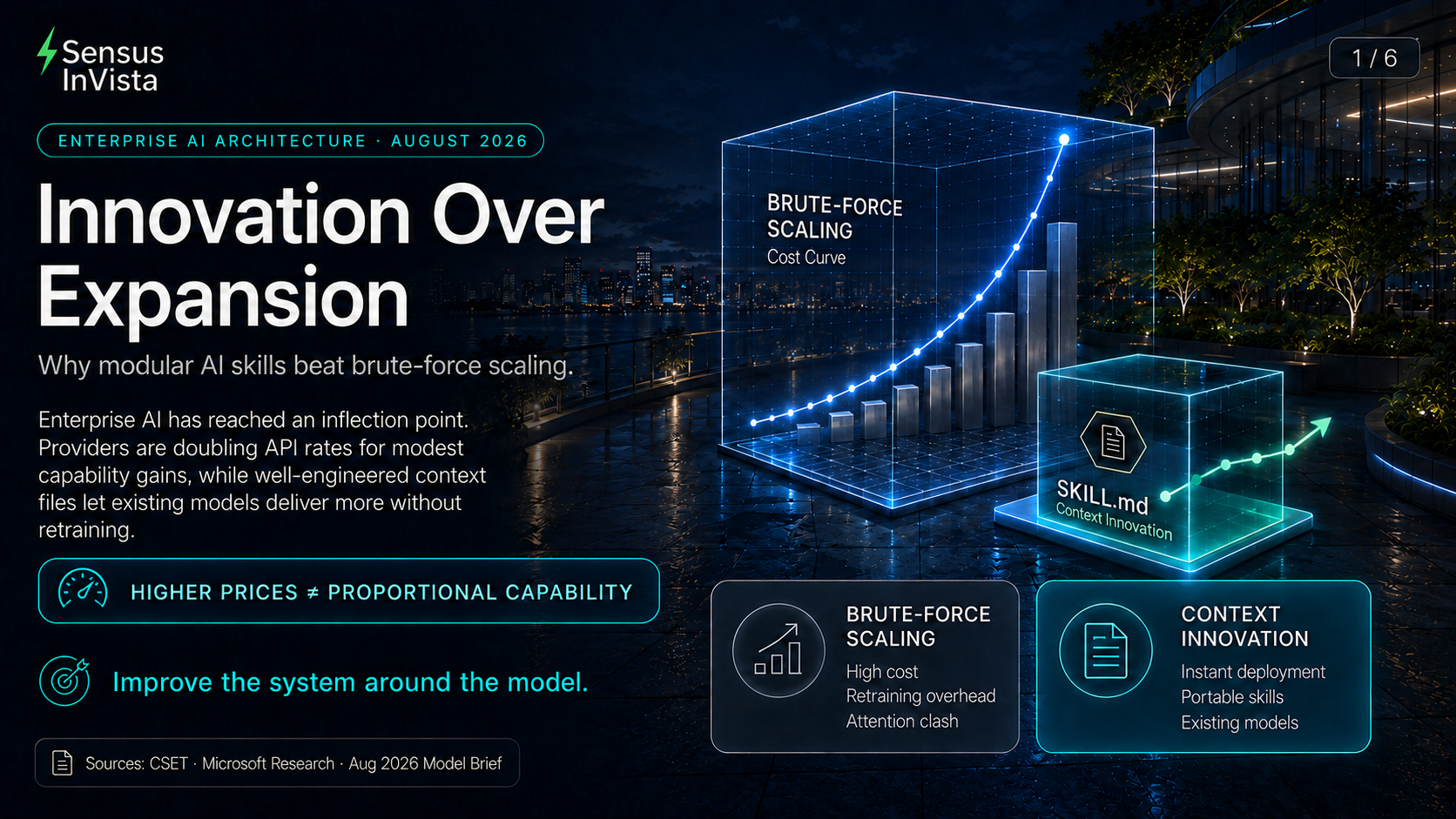
A Case for Innovation Over Expansion: Why AI Skills Beat Fine-Tuning
Commentary by Ethan James Farrell, Founder, Sensus InVista
We already have exceptionally capable models. The opportunity is to achieve more through better skills, context and alignment—not endless expansion.
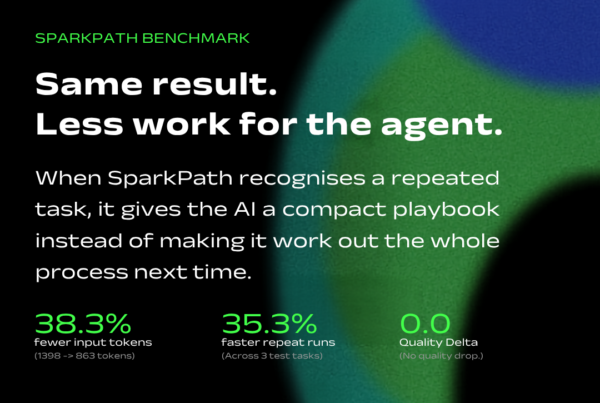
The AI industry has reached an inflection point. Research from Anthropic and Microsoft increasingly shows that well-constructed skills and context frameworks can reduce—or, for many tasks, remove—the need for fine-tuning. They can deliver similar or better results at a fraction of the cost, with far greater flexibility.

Model prices and model capability are not increasing at the same rate. Bigger is not automatically better value.
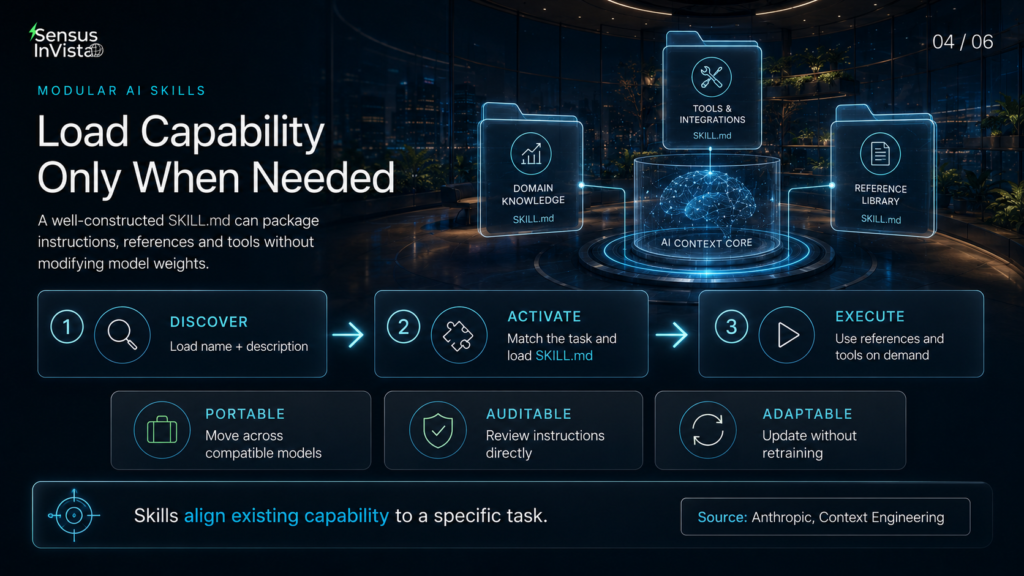
Why skills matter:
- Smaller models can achieve highly competitive, and sometimes frontier-level, performance when equipped with the right skills, context and tools.
- Switching or updating a skill file is vastly easier than running and validating a new training job.
- Cost-effectiveness can improve significantly compared with traditional fine-tuning.
- Businesses can achieve desirable AI outcomes without continuously expanding the underlying model.
- Skills are portable, auditable and easier to adapt as business requirements change.

The model did not change. The method did. Better context enabled a general model to outperform specialist tuning on MedQA.
Microsoft’s Medprompt research provides a clear example. Instead of fine-tuning a new specialist medical model, researchers combined GPT-4 with dynamic examples, structured reasoning and answer-choice shuffling. This produced a score of 90.2% on MedQA, exceeding the 86.5% achieved by the specialist Med-PaLM 2 model and reducing the error rate by 27%.
Expansion has human and physical limits. Innovation must also protect knowledge, resources and public benefit.
The broader point is not that fine-tuning has no place. It is that training should not be the automatic first response when stronger context, better instructions or a well-designed skill could achieve the same result more efficiently.
Recent analysis also suggests that marginal improvements in model performance are requiring disproportionately greater amounts of compute, capital, energy and data. The cost-value benefit of continual expansion is decreasing, yet the push for bigger models continues.

Expansion has human and physical limits. Innovation must also protect knowledge, resources and public benefit.
The case for stopping expansion:
- More than 1,100 AI professionals, researchers and engineers have supported calls for greater restraint in frontier model development.
- Security concerns being raised across the AI research community warrant serious attention.
- The environmental impact, water consumption and energy requirements of further expansion are substantial.
- Current models are already exceptionally capable.
- Much more could be achieved by improving how existing models are directed, equipped and applied.
There are serious ethical concerns too.
Reports that Anthropic acquired and destructively scanned large numbers of physical books for model training raise important questions about knowledge preservation and public access. The related court proceedings distinguished between scanning lawfully purchased physical books and retaining millions of pirated digital copies, but the wider ethical question remains.
If books are being destroyed for the consumption of commercial AI models, I hope to God that the knowledge they contain is also being preserved and made freely accessible online.
The idea that physical sources could be destroyed, absorbed into a proprietary system and then placed behind commercial access is dangerous. If that knowledge is already in short supply, its destruction without meaningful public preservation begins to resemble a modern form of book burning—particularly when companies are preparing to profit heavily from its inclusion within their models.
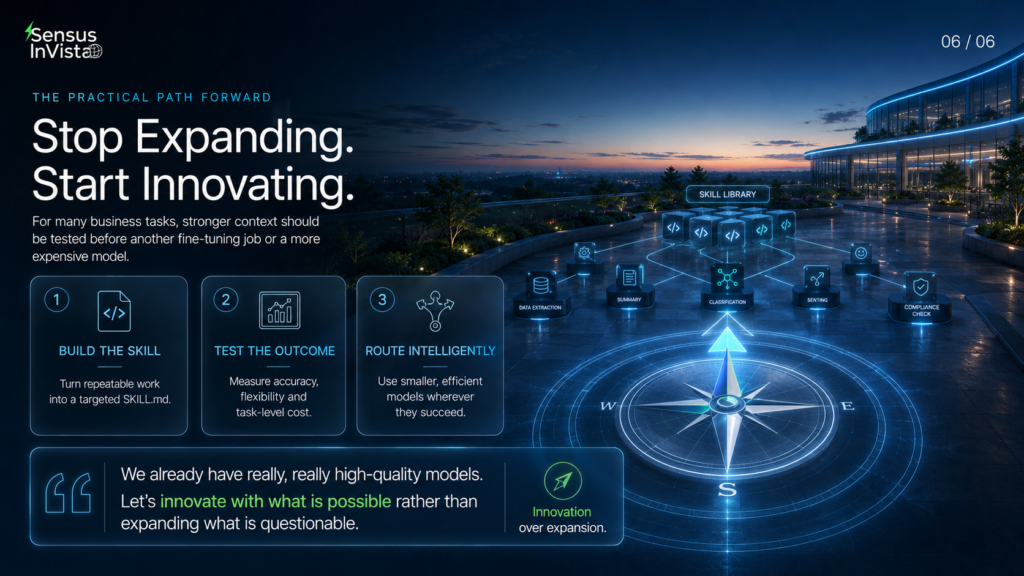
We already have really, really high-quality models. Let’s innovate with what is possible rather than expanding what is questionable.
The path forward:
Rather than pursuing bigger, greedier and increasingly all-encompassing models, we should focus on innovation with the capabilities already available.
High-quality skill creation offers a practical, cost-effective and flexible alternative. If there is a specific task to complete, build that task as a targeted skill or plugin—primarily as a skill—so it can harness the existing power of the model in the right alignment.
For businesses, that could mean turning operating procedures, specialist knowledge, compliance requirements and repeatable workflows into structured SKILL.md files. These can be loaded only when required, updated without retraining and used across different models or environments.
This is innovation over expansion: getting better results from what is already possible rather than assuming every problem requires a larger model, another training run or more infrastructure.
We already have really, really high-quality models.
Let’s innovate with what is possible rather than continuing to expand what is questionable.
References of interest:
- Anthropic — Effective Context Engineering for AI Agents
- Microsoft Research — Can Generalist Foundation Models Outcompete Special-Purpose Tuning? Case Study in Medicine
- Medprompt research paper — arXiv:2311.16452
- Pacing the Frontier — Open Statement
- Bartz v. Anthropic — CourtListener case docket
- Bartz v. Anthropic — June 2025 court order PDF
- Reuters — Explanation of the mixed fair-use and piracy ruling




Innovation over Expansion: A Case for Alternative Model Availability